

 Call us:



Cloud-Based Education ERP: The Future of Smart Educational Institution Management
The education sector has undergone a remarkable digital transformation over the last decade. Schools, colleges, universities, coaching centers, and training institutes are rapidly replacing manual administrative processes with intelligent digital solutions. At the heart of this transformation is the Cloud-Based Education ERP—a comprehensive platform that integrates academic, administrative, financial, and communication processes into one centralized system.
Managing student admissions, attendance, examinations, payroll, fee collection, transportation, library records, and parent communication through multiple disconnected systems often leads to inefficiencies, data duplication, and operational delays. A cloud-based Education ERP eliminates these challenges by providing a single platform accessible anytime, anywhere.
Whether you're managing a small private school or a multi-campus university, adopting a cloud-based ERP is no longer a luxury—it has become a necessity for delivering quality education with operational excellence.
What is a Cloud-Based Education ERP?
A Cloud-Based Education ERP (Enterprise Resource Planning) is an online software solution designed specifically for educational institutions. Instead of installing software on local computers or servers, the entire platform is hosted securely on cloud infrastructure, allowing authorized users to access it through the internet.
Unlike traditional management systems, cloud ERP connects every department into one unified ecosystem.
It helps institutions manage:
- Student Admissions
- Academic Planning
- Attendance Management
- Online Fee Collection
- Examination & Result Processing
- Human Resource Management
- Payroll
- Library Management
- Transport Management
- Hostel Management
- Parent & Teacher Communication
- Analytics & Reporting
The result is improved efficiency, transparency, and better decision-making across the institution.
Why Educational Institutions Are Moving to Cloud-Based ERP
Educational institutions today require flexible and scalable technology. Manual paperwork and disconnected software can no longer keep up with increasing student numbers and administrative complexity.
Cloud-based ERP solutions offer several advantages:
1. Access Anytime, Anywhere
One of the biggest advantages of cloud technology is accessibility.
School administrators, teachers, students, and parents can securely access the system using laptops, tablets, or smartphones from any location.
Whether checking attendance, submitting assignments, reviewing fee payments, or monitoring academic performance, everything is available in real time.
2. Centralized Data Management
A cloud ERP stores all institutional data in one centralized database.
Instead of maintaining separate spreadsheets or software for admissions, accounts, examinations, and HR, every department works from the same source of truth.
This eliminates duplicate records and improves data accuracy.
3. Improved Administrative Efficiency
Administrative teams spend countless hours on repetitive tasks.
Cloud-Based Education ERP automates:
- Admission processing
- Student registration
- Fee reminders
- Attendance tracking
- Timetable generation
- Report card creation
- Payroll calculations
Automation reduces manual work and minimizes human error.
4. Better Communication
Effective communication is essential for successful educational management.
Cloud ERP enables instant communication between:
- School Administration
- Teachers
- Parents
- Students
- Staff
Notifications, circulars, homework, exam schedules, fee reminders, and announcements can all be shared instantly through web portals and mobile applications.
5. Enhanced Data Security
Educational institutions manage highly sensitive student and staff information.
Modern cloud ERP solutions use:
- End-to-end encryption
- Role-based access control
- Automatic backups
- Disaster recovery systems
- Multi-factor authentication
- Secure cloud hosting
These security measures help protect institutional data from unauthorized access and accidental loss.
Essential Features of a Cloud-Based Education ERP
Choosing the right ERP depends on the features it offers.
Here are the most important modules every institution should consider.
Student Information Management
Maintain complete digital student profiles including:
- Personal details
- Academic history
- Attendance
- Examination records
- Fee history
- Medical information
- Certificates
Everything remains organized and easily searchable.
Online Admission Management
Digitize the entire admission lifecycle:
- Online applications
- Document uploads
- Verification
- Merit list generation
- Enrollment
- Admission confirmation
This simplifies admission for both institutions and applicants.
Attendance Management
Teachers can record attendance digitally.
Administrators receive real-time reports while parents receive instant notifications regarding student attendance.
Fee Management
Cloud ERP simplifies financial operations through:
- Online fee collection
- Automated invoices
- Payment reminders
- Digital receipts
- Scholarship management
- Financial reporting
It significantly reduces accounting workload.
Examination & Result Management
Educational ERP automates:
- Exam scheduling
- Question paper management
- Marks entry
- Grade calculation
- Report cards
- Result publishing
This ensures faster and error-free evaluation.
HR & Payroll Management
Institutions can efficiently manage:
- Employee records
- Attendance
- Leave requests
- Payroll processing
- Performance reviews
Everything is managed within one platform.
Library Management
Track:
- Books
- Issue and return dates
- Fine calculations
- Member records
- Inventory
This eliminates manual library registers.
Transport Management
Schools operating transport services can manage:
- Vehicle tracking
- Routes
- Driver details
- Pickup points
- Student allocation
Parents receive timely updates regarding transportation.
Benefits of Cloud-Based Education ERP
Better Decision-Making
Real-time dashboards provide valuable insights into:
- Student performance
- Attendance trends
- Financial reports
- Staff productivity
- Admission statistics
These analytics help management make informed decisions quickly.
Cost Savings
Cloud ERP removes the need for expensive local servers and reduces IT maintenance costs. Subscription-based pricing also makes it easier for institutions to scale according to their requirements.
Scalability
As institutions grow, cloud ERP can easily accommodate:
- Additional students
- Multiple campuses
- New departments
- Additional users
- New academic programs
There is no need for major infrastructure upgrades.
Faster Implementation
Unlike traditional software that requires complex installations, cloud ERP systems can often be deployed much more quickly, reducing downtime and accelerating digital transformation.
Increased Transparency
Parents can monitor:
- Attendance
- Homework
- Fee status
- Exam results
- Academic performance
Teachers and administrators also gain better visibility into institutional operations.
Who Should Use Cloud-Based Education ERP?
A Cloud-Based Education ERP is suitable for:
- Schools
- Colleges
- Universities
- Coaching Institutes
- Training Centers
- Educational Trusts
- Multi-campus Institutions
- Vocational Institutes
Regardless of institution size, cloud ERP improves operational efficiency.
How Cloud ERP Supports Digital Education
Digital education extends beyond online classrooms.
Modern institutions require integrated technology that supports:
- Hybrid Learning
- Online Examinations
- Digital Attendance
- Parent Portals
- Mobile Applications
- Virtual Communication
- Real-Time Reporting
Cloud ERP acts as the digital backbone that connects every academic and administrative process.
Choosing the Right Cloud-Based Education ERP
Before selecting an ERP solution, evaluate:
- Ease of use
- Mobile accessibility
- Cloud security
- Customization options
- Reporting capabilities
- Integration support
- Customer service
- Scalability
- Regular software updates
Selecting the right partner ensures long-term success.
Why Edu Manage Plus is a Smart Choice
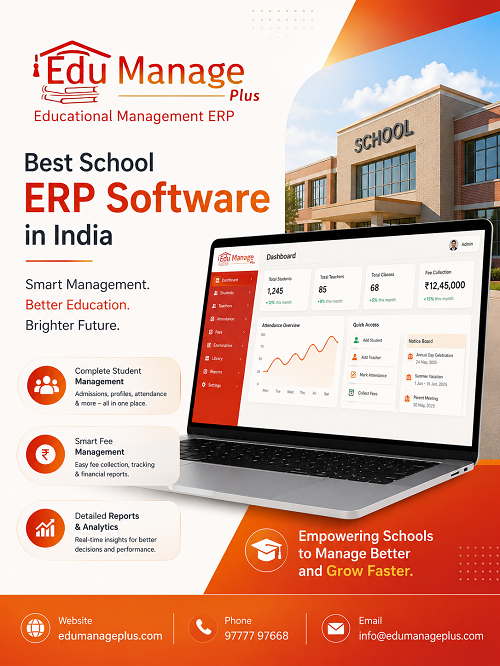
A comprehensive platform such as Edu Manage Plus offers institutions an integrated cloud-based solution that combines admissions, academic management, attendance, fee collection, examinations, HR, payroll, communication, analytics, and secure cloud infrastructure within a single system. Its centralized approach helps schools, colleges, and universities automate daily operations while improving transparency, collaboration, and data security.
Conclusion
Education is becoming increasingly digital, and institutions that embrace modern technology are better positioned to deliver exceptional learning experiences while streamlining operations.
A Cloud-Based Education ERP is more than just management software—it is a complete digital ecosystem that connects administrators, teachers, students, and parents through one intelligent platform.
By automating administrative tasks, improving communication, enhancing data security, and providing real-time insights, cloud ERP enables institutions to focus on what truly matters: delivering quality education.
If your institution is planning its digital transformation journey, investing in a reliable Cloud-Based Education ERP is one of the smartest decisions you can make for long-term growth and operational excellence.